
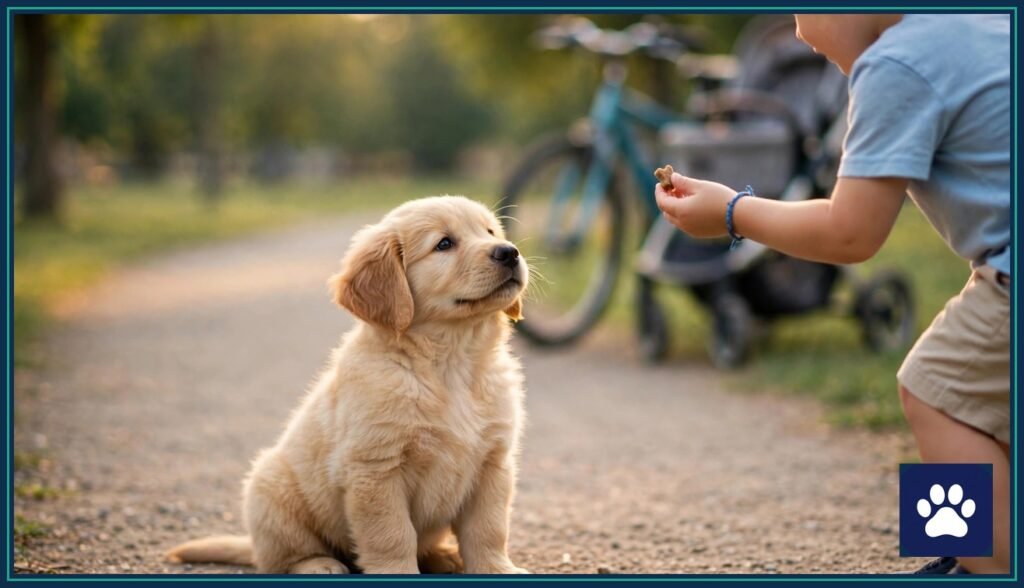
The puppy in your lap right now is a sponge — and the clock is ticking. Between roughly 3 and 14 weeks of age, your puppy’s brain is wired to accept new experiences as normal. After that window narrows (around 16 weeks), unfamiliar things start registering as suspicious instead of interesting. That makes a puppy socialization checklist one of the highest-leverage things you’ll do in your dog’s entire life: a planned list of 100 people, animals, sounds, surfaces, and handling experiences to work through before 16 weeks, done safely and at your puppy’s pace.
The short answer: Puppy socialization means controlled, positive exposure to new experiences — not forced interaction. Aim for about 100 encounters before 16 weeks across people, dogs, animals, places, sounds, surfaces, and handling. Keep every exposure short, let your puppy choose the distance, pair new things with treats, and watch body language for stress. You don’t need to wait until vaccines are complete: the American Veterinary Society of Animal Behavior considers socialization before full vaccination the standard of care, done safely (carried outings, vetted puppy classes, healthy known dogs). Always follow your own vet’s guidance on what’s safe in your area.
In this guide you’ll get what socialization actually means (and the common misunderstanding that derails it), the rules that make exposures count, how to socialize safely before vaccines are done, the full 100-item checklist broken into seven categories, a week-by-week plan, how to spot an overwhelmed puppy, and fixes for the mistakes most owners make. Pair this with our crate training guide — a well-socialized puppy who also loves their crate is a dramatically easier puppy.
What is puppy socialization (and what it isn’t)
Socialization is not “let your puppy play with every dog at the park.” It’s controlled, positive exposure to the world your puppy will live in: the people, animals, sounds, textures, and situations that make up normal life. The goal is simple — that when your adult dog encounters something new, their default response is curiosity rather than fear.
Two common misunderstandings derail the whole thing:
- Exposure does not require interaction. Your puppy does not need to greet every person, touch every object, or play with every dog. Watching a busy street from your lap while getting treats is socialization. Sitting calmly near a skateboard is socialization. Forced petting from strangers is not — it’s a risk.
- More is not automatically better. Ten calm, treat-paired exposures beat fifty chaotic ones. One frightening experience can undo weeks of good work, especially during fear periods. Quality, choice, and calm always win over volume.
Think of yourself as a tour guide, not a drill sergeant: you’re showing your puppy the world and making every stop pleasant.
Why the window closes at 16 weeks
Puppies are born with a developmental gift: during the first three months of life, sociability outweighs fear. New things are filed under “interesting” almost by default. The American Veterinary Society of Animal Behavior’s position statement on puppy socialization calls the first three months the primary and most important time for socialization, and notes that behavioral issues — not infectious disease — are the number one cause of death for dogs under three years of age, with poor early socialization a major contributor (k9petdogtraining.com).
Most puppies come home at 8 weeks, which leaves roughly eight weeks of open window. That’s plenty of time — you don’t need to do something dramatic every day. Two or three short, deliberate exposures a day, five days a week, will get you past 100 experiences well before 16 weeks.
After the window narrows, puppies can absolutely still learn — adult dogs learn new things all the time. It’s just slower and requires more careful work, because the brain’s default setting shifts toward caution. Missing the window doesn’t doom a dog, but using it well is the easiest training you’ll ever do.
The 5 golden rules of socialization
Every item on the checklist below only counts if you follow these rules. They matter more than the list itself.
1. Let your puppy choose the distance. New experience, big space, escape route. If your puppy wants to watch the vacuum from the hallway, that’s perfect — reward calm watching. Dragging a puppy toward something scary teaches them that new things are traps.
2. Pair new things with good things. Treats, praise, play — every novel experience should predict something your puppy loves. This is classical conditioning doing the heavy lifting for you.
3. Keep sessions short. Five to fifteen minutes of deliberate exposure beats an hour-long outing that ends in exhaustion. Puppies have short batteries; quit while it’s still fun.
4. Watch the body language. A relaxed puppy has a loose body, soft eyes, and a wagging tail held at a natural height. Stress looks like: tucked tail, yawning when not tired, lip licking, turning away, freezing, or trying to leave. If you see stress, calmly increase distance and try again another day — that’s a successful session, not a failed one.
5. One new thing at a time. Don’t combine the first thunderstorm recording with the first umbrella opening and the first car ride. Novelty stacks; overwhelm stacks faster.
Socializing safely before vaccines are complete
This is the question every new owner asks: how can I socialize before my puppy is fully vaccinated? The answer is that you absolutely can — and should — with sensible precautions.
The AVSAB position statement holds that it should be the standard of care for puppies to receive socialization before they are fully vaccinated, noting that the combination of maternal immunity, early vaccination, and appropriate care makes infection risk relatively small compared to the behavioral risk of missing the window (k9petdogtraining.com). The practical playbook:
- Carry your puppy through pet stores, farmers markets, and busy sidewalks instead of setting them on the ground.
- Host the world at home: invite friends over, run the vacuum, play sound recordings. Your living room is a zero-risk socialization venue.
- Choose a puppy class with health requirements (first vaccine set plus deworming, clean facility) rather than a free-for-all.
- Stick to healthy, known dogs — a friend’s calm, vaccinated adult dog is ideal. Avoid dog parks and high-traffic dog areas until your vet clears them.
- Talk to your vet about disease risk in your specific area. Local parvo prevalence genuinely changes the calculus, and your vet knows your neighborhood.
The rule of thumb: avoid unknown dogs and heavily trafficked dog ground; everything else is fair game with common sense.
The puppy socialization checklist: 100 experiences before 16 weeks
Print this, stick it on the fridge, and check items off as your puppy meets them calmly. Remember: each item counts when your puppy experienced it without fear — watching from a comfortable distance with treats absolutely counts.
People (20)
People are the single most important category. Your puppy should meet a wide variety of humans — different ages, looks, gaits, and gear.
- Adult men (many puppies find deep voices and large frames the most novel)
- Adult women
- Teenagers
- School-age children (calm, coached on gentle petting)
- Toddlers (at a distance, in a stroller or carried — unpredictable movement is the lesson)
- Elderly people (different gait, sometimes canes or walkers)
- People wearing hats
- People wearing sunglasses
- People in hoods or hoodies
- People with beards
- People in uniforms (delivery driver, mail carrier, police officer)
- Someone with an umbrella (closed, then opened at a distance)
- Someone using a cane
- Someone in a wheelchair
- Someone pushing a stroller
- A jogger passing by
- A cyclist passing by
- Someone wearing gloves
- Someone carrying a large backpack or luggage
- People of different ethnicities and accents than your household
Dogs and other animals (14)
Dog-to-dog socialization is about calm coexistence, not wrestling marathons. One or two polite, well-matched playmates beat a dozen chaotic ones.
- A calm, vaccinated adult dog (small breed)
- A calm, vaccinated adult dog (large breed)
- A friendly puppy of similar age and size
- An older, tolerant senior dog
- Watching dogs from a distance (across the street, from the car)
- A cat — at a distance, behind a barrier, or a calm cat that ignores puppies
- Birds (pigeons in the park, a pet bird in a cage)
- Squirrels or rabbits seen on a walk
- Horses (from a fence, at a distance)
- Cows, goats, or chickens (farm visit or petting zoo)
- Fish in a tank (movement and reflections)
- A dog wearing a cone, coat, or booties (looks strange — normalize it)
- Hearing dogs barking at a distance (not being rushed by them)
- A polite on-leash greeting with a known friendly dog (3 seconds, then move on happily)
Places (16)
New environments teach your puppy that “different place” doesn’t mean “dangerous place.” Keep visits short and treat-rich.
- Your vet’s office — a happy visit with treats and no exam
- A pet store (carried, or in a cart)
- A quiet residential sidewalk
- A busy street with traffic
- A park (on leash, observing)
- A parking lot (cars moving, doors slamming)
- A friend’s or family member’s house
- Riding in the car (short trips that end somewhere fun)
- A pet-friendly café patio (under the table, watching the world)
- An elevator
- Stairs (up and down, at puppy pace)
- A school playground — outside the fence, watching children play
- A farmers market (carried)
- A hardware store or garden center that allows dogs
- A drive-through (new voices at the window, food smells)
- Nighttime walk around the block (same route, totally different sensory world)
Sounds (16)
Sound sensitivity is one of the most common adult behavior problems — and one of the most preventable. Play recordings at low volume first, paired with treats, and build up gradually.
- Vacuum cleaner (off, then on in another room, then closer)
- Blender or food processor
- Hair dryer
- Doorbell and knocking
- Thunderstorm recording (low volume, treats raining)
- Fireworks recording (same protocol — start barely audible)
- Traffic sounds (trucks, buses, motorcycles)
- Sirens (police, fire, ambulance)
- Construction noise (jackhammer, drilling)
- A baby crying (recording or the real thing at a distance)
- Applause and cheering (sports on TV works)
- Music — different genres, some with bass
- Skateboard sounds (wheels on pavement, tricks)
- Lawn mower or leaf blower (from inside the house first)
- Smoke alarm test beep (brief, paired with treats)
- Garage door opening and closing
Surfaces and textures (12)
Puppies who only walk on living-room carpet can find the real world literally shaky underfoot. Let your puppy choose to step on each one — treats for brave paws.
- Wet grass
- Concrete and pavement
- Gravel
- Tile or linoleum (slippery — go slow)
- Hardwood floors
- A metal grate or manhole cover
- A rubber mat or yoga mat
- Sand (a sandbox, a beach, a volleyball court)
- Mud or a shallow puddle
- Cardboard (a flattened box to walk over)
- A wobble board or slightly uneven surface
- Snow or ice (season permitting — even a bag of ice cubes on a tray works)
Objects and sights (12)
Everyday objects look alien at puppy eye level. Novelty plus treats equals confidence.
- An umbrella opening (at a distance first)
- Balloons (tied down — never let a puppy bite one)
- Plastic bags rustling
- A bicycle (stationary, then being walked, then ridden past)
- A skateboard (stationary, then rolling)
- A wheelchair or walker moving
- A stroller moving
- A mirror (their own reflection surprises most puppies)
- Flags or kites flapping
- A broom or mop moving
- A rolling suitcase
- Holiday decorations (inflatable yard figures are puppy kryptonite — start far away)
Handling and grooming practice (10)
A puppy who accepts handling grows into a dog who’s easy at the vet and groomer. Practice a little every day — touch, treat, release.
- Paws touched and held (each paw, briefly)
- Ears lifted and looked into
- Mouth opened, teeth and gums touched
- Tail gently touched and lifted
- Belly rubs and being touched all over
- Gentle restraint — a brief, calm “hug” hold, then release and treat
- Nail clipper or grinder touching the paws (sound + touch, no pressure at first)
- Brushing with a soft brush
- Wearing a collar, then a leash dragging under supervision
- Being picked up and held (for small breeds — support fully, keep it brief and positive)
That’s 100. If you reach 16 weeks with 70 calmly checked off, you’ve done genuinely excellent work — don’t chase the number at the cost of your puppy’s comfort.
A simple week-by-week plan (weeks 8–16)
You don’t need a spreadsheet — but a loose rhythm keeps you from stalling. Here’s one that fits real life:
- Weeks 8–9: Home base. Handling practice daily, household sounds, 5–8 different visitors, first car rides, first happy vet visit. Start crate training in parallel with our crate training guide.
- Weeks 10–11: Expand the bubble. Carried outings to pet stores and markets, first puppy class, surfaces and objects at home, sound recordings at low volume. Follow your puppy potty training schedule so outings don’t create accidents — potty first, always.
- Weeks 12–13: The world opens up. Sidewalk walks (as your vet advises), parks, café patios, meeting calm dogs, busier sounds at higher volume. This is peak sponge time — use it.
- Weeks 14–16: Fill the gaps. Check your list, target the categories you’re light on (usually: men with hats, livestock, elevators), and revisit anything your puppy found tricky — at an easier distance, with better treats.
Two to three deliberate exposures a day is the sweet spot. Fold them into life you’re already living: the mail carrier, the garbage truck, the neighbor’s kid — the world provides the curriculum if you pay attention.
Signs your puppy is overwhelmed (and what to do)
Not every exposure goes perfectly, and that’s fine — what matters is how you respond. Learn the stress signals:
- Mild stress: yawning when not tired, lip licking, turning the head away, sniffing the ground suddenly, moving slowly. Response: increase distance, let them watch, reward calm.
- Moderate stress: tucked tail, crouching, trying to move away, refusing treats they normally love. Response: calmly leave the situation. No scolding, no coaxing — just go. Try again another day at half the intensity.
- Over threshold: freezing, frantic scrambling to escape, barking/lunging, or shutting down completely. Response: get them out, keep your own energy boring and calm, and don’t retry that stimulus for several days. If it happens repeatedly with ordinary things, talk to your vet or a certified trainer early — early intervention works far better than waiting.
A puppy who “seems fine” but won’t take treats is telling you something: treat refusal is information. A relaxed puppy eats. A stressed puppy can’t. Adjust accordingly.
Socialization mistakes to avoid
- Flooding: dumping a puppy into the deep end — the chaotic dog park, the crowded festival — hoping they’ll “get used to it.” Sometimes they shut down, which looks like calm but isn’t. Build intensity gradually instead.
- Forcing greetings: every stranger does not need to pet your puppy. “They’re in training, but you can toss a treat” protects your puppy and still socializes.
- Only socializing with dogs: dog-obsessed puppies who can’t handle the human world are a common outcome of puppy-class-only socialization. Dogs are one category of fourteen-ish — keep the mix.
- Stopping at 16 weeks: the window narrows, but maintenance matters. Keep exposing your adolescent dog to the world or early gains fade — “use it or lose it” applies.
- Waiting for full vaccination to start: as covered above, this wastes the most valuable weeks. Socialize safely now, with your vet’s guidance on local risk.
- Skipping the boring stuff: nail trims, ear checks, and being handled by the vet tech prevent some of the most common adult handling problems. The unglamorous items on this list pay the biggest dividends.
Frequently asked questions
What is the 100-person socialization rule for puppies?
It’s a popular goal — expose your puppy to 100 different people (or 100 new experiences) before 16 weeks — meant to make socialization concrete and countable. Treat it as a motivating target, not a medical prescription: 70 calm, positive experiences beat 100 rushed ones, and the experience should always be your puppy’s choice at a comfortable distance.
Can I socialize my puppy before vaccinations are complete?
Yes, with precautions. The American Veterinary Society of Animal Behavior considers socialization before full vaccination the standard of care. Carry your puppy in public places, host visitors at home, choose puppy classes with health requirements, stick to healthy known dogs, and avoid dog parks and heavily trafficked dog areas until your vet clears them. Confirm the plan with your own vet, since local disease risk varies.
What if my puppy is scared of something on the checklist?
That’s information, not failure. Increase the distance until your puppy notices the thing without fear, reward calm behavior, and end the session. Revisit it another day at an easier level — this gradual approach is called desensitization. Never force a frightened puppy closer; flooding usually makes fear worse, not better.
Is 16 weeks too late to socialize a puppy?
No — 16 weeks is when the easiest window narrows, not when learning stops. Dogs learn throughout life. An older puppy or adolescent just needs the same checklist done more gradually, with more repetitions and higher-value rewards. If fear is already entrenched, a certified trainer or veterinary behaviorist can help much faster than trial and error.
How do I socialize a puppy with other dogs safely?
Choose calm, vaccinated, known dogs over random ones; keep first meetings short (a few seconds of greeting, then move on); prioritize parallel walking and calm coexistence over wild play; and skip dog parks until your vet approves. One polite adult dog who ignores your puppy is worth more than ten rowdy playmates.
Should socialization include grooming and vet handling?
Absolutely — it’s some of the highest-value socialization there is. Daily two-minute handling sessions (paws, ears, mouth, tail, gentle restraint) plus happy vet visits with treats build a dog who’s easy to examine, groom, and treat medically for life. Pair every touch with a treat at first, then fade the treats as acceptance becomes habit.
🐾 Free tools for the socialization window
Socialization is one piece of the puppy puzzle — the right daily routine ties it all together. BlueTarg’s free tools are built for exactly this stage:
- Dog Wellness Planner quiz — a free personalized daily routine for your puppy in about 60 seconds, with socialization outings baked in.
- Puppy Plan Quiz — answer a few questions and get a training roadmap matched to your puppy’s age and stage.
- Dog Exercise Needs Finder — age-appropriate activity levels, because a well-exercised puppy socializes better than a wired one.
- How to Crate Train a Puppy — pair socialization days with calm crate naps; overtired puppies don’t learn well.
Want the Pro versions — saved puppy profiles, vet-ready health history, and printable plans? Pro Pet Pass is $7/month, free for the first 14 days.
Sources: American Veterinary Society of Animal Behavior, “Position Statement on Puppy Socialization” (via k9petdogtraining.com). This article is educational and doesn’t replace your veterinarian’s advice — especially on vaccination timing and local disease risk.