
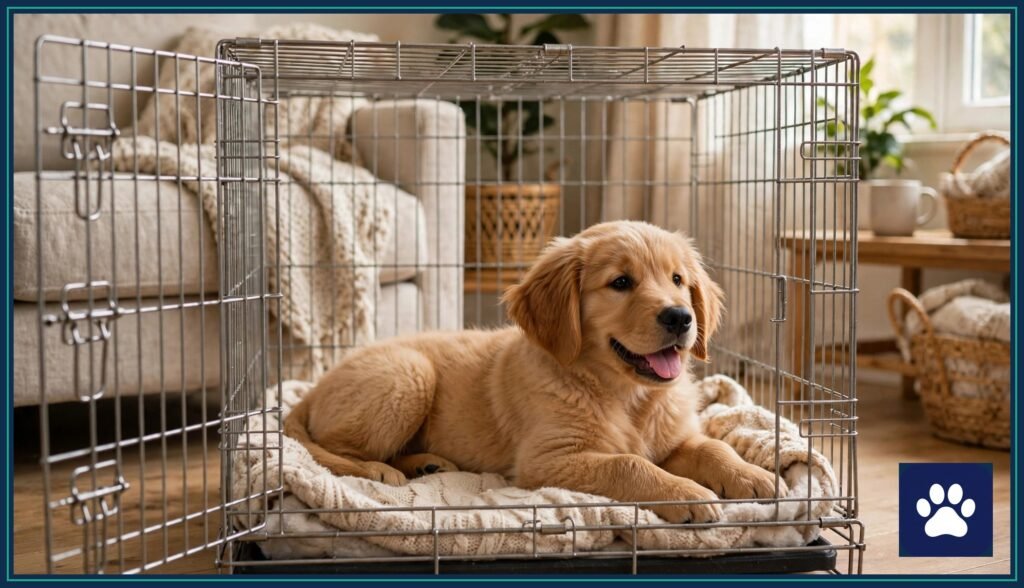
Staring at a crate in the corner and a puppy who treats it like a prison cell? You’re not doing anything wrong — you’re just missing the sequence. Learning how to crate train a puppy isn’t about forcing your dog inside and waiting out the protests. It’s about a short, deliberate process that turns the crate into the best spot in the house: their own private bedroom.
The short answer: Crate train your puppy in five short phases over about a week: make the crate a treat dispenser (days 1–2), feed meals inside it (days 2–3), close the door for seconds then minutes (days 3–5), leave the room briefly (days 5–7), and then use it for naps and bedtime. Never use the crate as punishment, and never crate longer than your puppy can comfortably hold their bladder.
In this guide you’ll get the crate setup that works (type, size, and placement), the exact day-by-day phases trainers recommend, the rules that make it stick, fixes for crying and accidents, and the timeline for when your puppy can be trusted without the crate. Pair this with our puppy potty training schedule — the crate and the schedule are a team.
Why does crate training work?
A crate works with your puppy’s instincts, not against them. Dogs are den animals — they naturally seek out small, enclosed spaces for rest. A crate is simply a den you provide, and it serves four practical jobs at once:
- House training. Dogs avoid soiling their sleeping area, so a properly sized crate teaches your puppy to hold it between breaks. The AKC’s crate training guidance leans on exactly this instinct (akc.org).
- Safety and management. When you can’t supervise — cooking, on a call, out of the house — the crate keeps your puppy away from cables, cleaning supplies, and furniture-chewing temptations.
- A calm-down zone. Overtired puppies behave like overtired toddlers: wild, mouthy, and unable to stop themselves. A crate gives them a boring place to actually fall asleep.
- Travel and vet readiness. A puppy who loves their crate travels in a car crate or rests in a vet kennel without panic. That’s a lifelong skill.
None of this works if the crate feels like punishment. The entire method below rests on one principle: the crate is where good things happen, and only where good things happen.
Choosing the right crate
Buying the right crate first saves you re-buying it later. Get these three decisions right and training gets noticeably easier.
Wire vs. plastic vs. fabric crates
Wire crates are the best all-rounder for puppies: well-ventilated, collapsible, and most come with a divider panel so one crate can grow with your dog. The downside is visibility — a puppy who can see every distraction sometimes struggles to settle, which is easily fixed with a blanket draped over the top and sides.
Plastic kennels (airline-style) feel more den-like out of the box, which some puppies find calming. They’re harder to clean thoroughly and bulkier to store, and the divider options are limited.
Fabric crates are light and fold flat, but a chewing puppy will destroy one in an afternoon. Save fabric for later, once your dog is reliably crate-trained.
For most puppies, a wire crate with a divider panel is the safest first purchase.
Sizing: the Goldilocks rule
The crate should be big enough for your puppy to stand up, turn around, and lie down comfortably — and no bigger. Too much space, and a puppy will simply sleep in one corner and potty in the other, which defeats the entire house-training benefit. This is the mistake behind most crate accidents.
If you buy an adult-size crate for a growing puppy, use the divider panel to shrink the living area now and move it back as your puppy grows. Check the sizing chart on the manufacturer’s site against your breed’s expected adult weight, and size for the adult — a too-small adult crate is uncomfortable, and you’ll only buy it twice.
Where to put the crate
Place the crate where the family spends time — a living room corner or bedroom — not in a garage or isolated laundry room. A puppy banished to a remote corner will feel punished, no matter how many treats you toss in. During the first weeks, many owners keep the crate in the bedroom at night so they can hear early stirring and get the puppy out before an accident.
Avoid direct sunlight, drafty spots, and right next to a speaker or TV. Quiet, room temperature, and near you: that’s the formula.
What goes inside (and what doesn’t)
Do put in: a washable crate pad or folded blanket (washable matters — accidents happen), one or two safe chew toys, and a stuffed puzzle toy like a Kong during training sessions to build positive associations.
Don’t put in: a full food or water bowl for unsupervised crating (spills, and drinking leads to needing to go), rawhide or any chew that can be swallowed in pieces when you’re not watching, or anything with stuffing a heavy chewer can tear open unsupervised.
A light blanket over the top and sides can mimic the den feel and reduce visual distraction — but leave the front open for airflow, and remove the cover if the crate gets warm.
How to crate train a puppy step by step
This is the core of it. Five phases, roughly a week, with each phase only starting when the previous one is easy. Rushing is the single biggest reason crate training fails — if a phase feels hard, repeat it for another day rather than pushing ahead.
Phase 1: Make the crate a treat dispenser (days 1–2)
Set up the crate with the door fixed open so it can’t swing shut and startle your puppy. Now play a simple game: every time your puppy glances at the crate, walks toward it, or sniffs it, mark it (“yes!”) and toss a treat inside the crate. Let them go in, eat, and walk back out freely — no pressure, no closing the door.
Scatter a few treats inside the crate throughout the day for your puppy to discover on their own. Feed a stuffed Kong just inside the door. The goal by the end of day two: your puppy happily wanders in and out of the crate on their own, because good things keep appearing in there.
Do not force your puppy inside. If they’re nervous, slow down — toss treats closer to the entrance and celebrate smaller steps.
Phase 2: Feed meals in the crate (days 2–3)
Start serving meals in the crate: place the bowl just inside the door at first, then move it further back over a few meals until your puppy is comfortably eating with their whole body inside. This builds a powerful association — meals are among the best things in a puppy’s day — and it requires zero extra training time since you’re feeding anyway. Consistent meals also make potty timing predictable; our free Dog Food Portion Calculator helps you get amounts right by age and weight.
While they’re eating, you can gently close the door — then open it the moment they finish. The first few times, they’re too focused on dinner to notice the door at all. If they do notice and fuss, open it, and try closing it for a shorter stretch next meal.
Phase 3: Close the door for seconds, then minutes (days 3–5)
Now build door-closed time deliberately. After your puppy enters (toss a treat or give a cue like “crate” or “bed”), close the door and immediately reward through the bars. Sit right next to the crate for a minute or two, then let them out calmly.
Stretch it gradually: 1 minute, then 3, then 5, then 10. Always let them out before they get upset — you’re teaching them that the door always opens and confinement is boring, not scary. Keep a stuffed Kong or chew in the crate so door-closed time is treat time. If your puppy fusses, wait for a quiet moment before opening — opening mid-whine teaches that whining opens doors.
By the end of this phase, aim for a relaxed 20–30 minutes with you nearby.
Phase 4: Leave the room briefly (days 5–7)
Once your puppy is calm with the door closed while you’re beside the crate, start adding distance. Step a few feet away for a few seconds, return, reward, open. Then step into the hallway. Then leave the room for a minute. As the AKC’s step-by-step guide notes, work only one dimension at a time — don’t increase distance and duration simultaneously (akc.org).
Mix short easy repetitions with slightly longer ones so your puppy never learns to dread the long ones. Vary your routine: grab your keys and sit back down, put on your shoes and make coffee — otherwise your puppy learns that shoe sounds predict abandonment and gets anxious at the first lace.
Phase 5: Crate for naps and bedtime (week 2 onward)
Start using the crate for real life: enforced naps (puppies need a lot of sleep and won’t always choose it), bedtime, and your brief absences. Always potty first, then crate; always crate-to-potty when you let them out. Our Dog Exercise Needs Finder helps you give age-appropriate activity before crate time — a tired puppy settles far faster than a wired one.
Keep sessions short at first and build up. The ceiling is always the same: no longer than your puppy can comfortably hold their bladder — the “one hour per month of age” rule from our potty training schedule applies directly to crate time.
The golden rules of crate training
These five rules separate crate training that works from crate training that backfires:
- Never use the crate as punishment. The crate must always mean good things. If you need a time-out for bad behavior, use a different room or pen — never the crate.
- Crate time is limited by bladder, not convenience. A young puppy physically cannot hold it for a full workday. Match absences to the max-hold column in the potty schedule; longer gaps need a midday helper, a walker, or a pen setup with a potty area instead.
- Tire them out first. Exercise and a potty break before crating, every time. Crating a full-energy puppy and hoping for calm is a setup for failure.
- Keep arrivals and departures boring. Don’t throw a party when you leave or return — calm energy in, calm energy out. Dramatic goodbyes teach your puppy that departures are events worth worrying about.
- Let them out only when calm. Wait for a quiet moment before opening the door, and ask for a sit if they’re old enough to know one. What gets rewarded gets repeated — make calm the thing that opens the door.
Crate training troubleshooting
Most crate problems have one of a few causes. Here’s how to fix each.
My puppy cries or barks in the crate
First, rule out needs: do they need to potty, are they overtired, did they get enough exercise, is it too hot or cold? Then check whether you moved too fast — crying usually means the previous phase wasn’t solid yet. Go back one phase and rebuild.
For mild fussing at the start, wait for a pause in the noise before opening the door so you don’t reward the barking. For genuine distress (panting, drooling, frantic digging or biting at the bars), don’t “wait it out” — that’s panic, not protest, and forcing through it makes things worse. Slow the whole program down and rebuild the positive association. If distress is severe or persistent, talk to your vet or a certified trainer — some puppies need a different approach.
My puppy has accidents in the crate
Almost always one of three things: the crate is too big (shrink it with the divider), the session is longer than bladder capacity (shorten it), or the puppy hasn’t pottied right before going in. Clean every accident with an enzymatic cleaner, not ammonia-based products — leftover scent marks the spot as a bathroom.
Repeated soiling despite a small crate and short sessions deserves a vet check: urinary tract infections are a common, treatable cause, and no amount of retraining fixes a medical problem.
My puppy won’t go in at all
You skipped Phase 1, or moved through it too fast. Go back to treats-appearing-in-the-crate with the door open and no pressure. Try higher-value rewards — tiny bits of chicken or cheese beat dry kibble for a nervous puppy. Feed every meal in the crate for a few days. Most reluctant puppies come around within a week of consistent, pressure-free positive association.
My puppy chews the crate bars or digs at the floor
Usually boredom, excess energy, or frustration at being left too long. Add more exercise before crating, provide a safe chew (a frozen stuffed Kong works well), and shorten sessions. If bar-chewing is intense enough to damage teeth, talk to your vet about whether the crate setup or schedule needs changing.
My puppy screams at night but is fine during the day
Nighttime crying in the first week is usually loneliness — your puppy just left their littermates. Keep the crate in your bedroom so your presence calms them, and keep overnight trips boring: leash on, potty, straight back. Set an alarm for planned potty trips rather than waiting for crying, so they don’t learn that crying summons you. Most puppies settle into the nighttime routine within the first one to two weeks.
How long does crate training take — and when can you stop?
With consistent daily sessions, many puppies are comfortable with the crate basics within one to two weeks. Anxious puppies, older rescue dogs with no crate history, or puppies who had a bad first experience can take several weeks — that’s normal, not failure.
Being crate-trained and being done with the crate are different things. Most owners keep using the crate for naps and bedtime for the first 6–12 months, then test short unsupervised periods outside it — first with a puppy-proofed single room, then gradually more space. Signs your dog is ready for more freedom: months without accidents, no destructive chewing when supervised, and calm behavior when left briefly. If freedom brings regression, go back to the crate without guilt — it’s a tool, not a verdict.
Many adult dogs keep loving their crate for life as a quiet retreat. Leaving it available with the door open costs you nothing and gives your dog a bedroom of their own.
Special cases
Adult rescue dogs: the same five phases apply, just potentially slower. A rescue with unknown crate history may associate confinement with something bad — rebuild from Phase 1 with extra patience, and consider that some adult rescues genuinely do better with a pen than a crate.
Working full time: a young puppy cannot be crated for a full workday — that’s beyond bladder capacity and fairness. Use a puppy pen with a potty area, arrange a midday walker, or combine crate time with doggy daycare. Our guide to how long you can leave a dog alone helps you plan coverage honestly.
Apartment living: crate training is arguably more important in apartments, where unsupervised access means more neighbors and more damage. The phases are identical; just be extra mindful of noise — proactive training beats angry-neighbor-driven training.
Frequently asked questions
Is crate training cruel?
No — when done right, it’s the opposite. Dogs are den animals, and a properly introduced crate becomes a safe, cozy retreat your dog chooses voluntarily. What would be unfair is using the crate as punishment or leaving a dog confined far beyond their bladder capacity. The crate is a bedroom, never a jail cell.
How long can I leave my puppy in the crate during the day?
No longer than they can comfortably hold their bladder — the widely used guideline is about one hour per month of age, as a ceiling rather than a target. An 8-week-old puppy needs a break every 1–2 hours; a 4-month-old can manage around 4 hours. See our age-by-age potty schedule for the full table.
Should I cover my puppy’s crate at night?
A light blanket over the top and sides can help by mimicking a den and blocking distractions, and many puppies settle faster with one. Keep the front uncovered for airflow, make sure the crate doesn’t get warm, and remove the cover if your puppy pulls it in and chews it.
My puppy cries all night in the crate. Should I just ignore it?
Don’t ignore crying blindly — first rule out a genuine need (potty, too hot, too cold, distress). For mild protest whining in a puppy whose needs are met, waiting for a quiet pause before responding teaches them that calm gets attention. But frantic crying with panting or drooling is panic, not protest — comfort your puppy and slow the training down rather than forcing through it. When in doubt, check with your vet.
Can you crate train an older puppy or adult dog?
Yes. The same five phases work for dogs of any age — adult dogs often learn faster because they have better bladder control and longer attention spans. The exception is a dog with a genuine confinement phobia from past trauma; those dogs need desensitization work with a professional, not a standard crate program.
What should I do if my puppy keeps pooping in the crate?
Check the three usual causes: crate too big (use the divider), sessions too long (shorten them), and no potty break immediately before crating. Make sure meals are on a consistent schedule — regular feeding makes elimination predictable — and clean thoroughly with an enzymatic cleaner. If it continues despite all of that, see your vet to rule out digestive or urinary issues.
🐾 Free tools for the puppy phase
The crate is half the battle — the right routine is the other half. BlueTarg’s free tools are built for exactly this stage:
- Dog Wellness Planner quiz — a free personalized daily routine for your puppy in about 60 seconds, crate naps and all.
- Puppy Potty Training Schedule — the age-by-age break timetable your crate sessions should follow.
- Dog Exercise Needs Finder — age-appropriate activity so your puppy is pleasantly tired — not wired — at crate time.
Want the Pro versions — saved puppy profiles, vet-ready health history, and printable plans? Pro Pet Pass is $7/month, free for the first 14 days.
Sources: AKC, “Step-by-Step Crate Training for Your Dog” (akc.org/expert-advice/training/crate-training-step-by-step/); AKC, “Crate Training a Puppy: How to Potty Train Your Dog” (akc.org). This article is educational and doesn’t replace your veterinarian’s advice.