
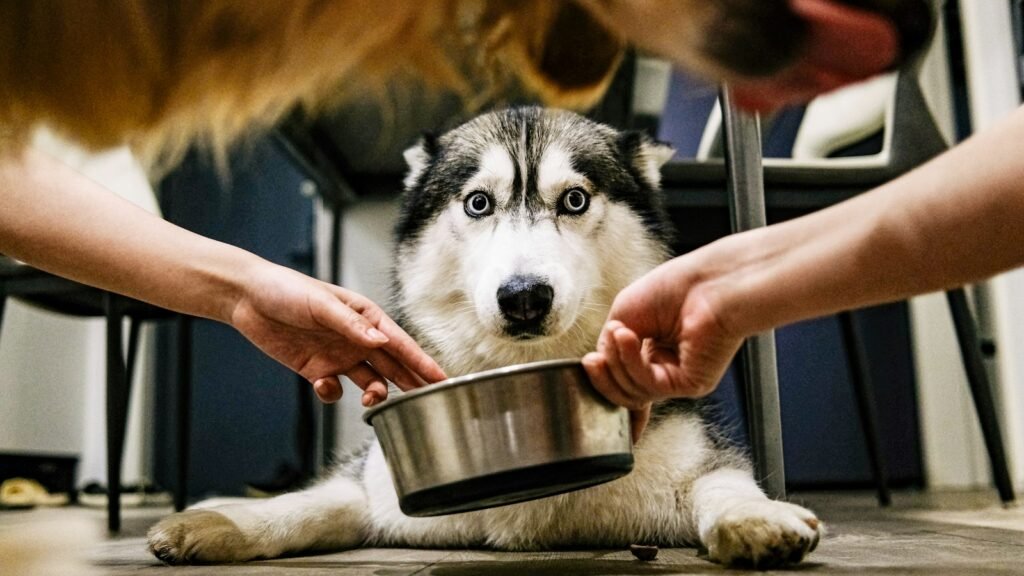
Quick answer: Feed a food whose label carries an AAFCO statement for “growth” or “all life stages”. Most puppies eat four meals a day until around four months, three until about six months, then two. Judge the portion by your puppy’s body condition, not by the number on the bag. Keep treats under 10% of the day’s calories, and leave fresh water down all day.
Why puppy wellness starts in the bowl
The first twelve months are the only window your puppy gets for building a skeleton, an immune system and a brain. Food is not just fuel during that year, it is raw material. Get it roughly right and almost nothing else about feeding will matter much for the rest of their life. Get it badly wrong, especially on portion size and growth rate, and the consequences show up years later as joint disease and excess weight.
The good news is that “roughly right” is genuinely achievable. You do not need a boutique brand or a supplement shelf. You need a complete food formulated for growth, a consistent schedule, and the habit of putting your hands on your puppy once a week.
The one sentence on the bag that actually matters
Ignore the photography on the front. Turn the bag over and find the nutritional adequacy statement, usually in small print near the ingredients. It will say something close to: “formulated to meet the nutritional levels established by the AAFCO Dog Food Nutrient Profiles for growth” or “for all life stages”.
That single sentence is the difference between a complete diet and an expensive snack. A food labelled for “adult maintenance” only is not formulated for a growing puppy, however premium it looks.
If your puppy is likely to weigh more than about 70 lb (32 kg) as an adult, look for one extra phrase: the statement should include growth of large-size dogs. Large-breed puppy formulas are built with tighter limits on calcium and energy density, because a big puppy growing too fast is the single most avoidable cause of developmental joint problems.
The puppy nutrition roadmap, by age
- 8 to 12 weeks. Your puppy has just finished weaning and has a stomach the size of a walnut. Four small meals a day keeps blood sugar stable. This matters most in toy breeds, where a missed meal can genuinely cause a hypoglycaemic wobble. Keep the food the breeder or shelter was using for the first week, even if you plan to change it.
- 3 to 6 months. Drop to three meals. This is the fastest growth phase and also when most owners accidentally overfeed, because a puppy this age acts hungry regardless of how much they have eaten. Start checking body condition weekly.
- 6 to 12 months. Two meals a day is standard from here on. Growth slows, appetite often drops for a week or two, and that is normal rather than a problem.
- Moving to adult food. Small and toy breeds are usually ready around 10 to 12 months. Large and giant breeds should stay on puppy food longer, commonly 18 to 24 months, because their skeleton is still finishing.
How much to feed: the bag is a starting point, your puppy is the answer
Feeding charts on packaging are population averages. They cannot know whether your puppy is a couch dweller or a small tornado, whether they have been neutered, or how cold your house is. Use the chart to pick a starting amount, then let the dog correct it.
Once a week, run your hands over your puppy and check three things:
- Ribs. You should feel them easily with flat hands and light pressure, like the back of your knuckles. If you have to press, there is too much covering. If they are sharply visible from across the room, there is too little.
- Waist from above. Looking down, there should be a visible narrowing behind the ribcage. A straight or bulging outline means the portion is too big.
- Tuck from the side. The belly should rise up towards the back legs rather than running level with the chest.
If the picture is wrong, change the daily amount by about 10% and give it two weeks before judging again. Small, slow adjustments beat dramatic ones. Weigh the food rather than scooping it, because a “cup” varies wildly between people and a 20% error every meal compounds fast.
Related: For adult dogs, see how much you should feed your dog.
Tracking weight alongside body condition makes the trend obvious long before it is visible. Our weight tracker plots the curve for you, and the puppy timeline lays out what else should be happening at each age.
Large-breed puppies are a different problem
With a Labrador, German Shepherd, Great Dane or any other dog heading past 70 lb, the instinct to grow them big and grow them fast is exactly backwards. Cartilage and bone in a large-breed puppy mature on a fixed timetable. Pushing body mass ahead of that timetable, with excess calories or excess calcium, loads joints that are not ready to carry it.
Long-term feeding studies in Labradors found that littermates kept lean throughout life developed hip arthritis later and lived meaningfully longer than those fed freely. Keeping a big puppy on the lean side of normal is not deprivation. It is the single most protective thing you can do for their joints, and it costs nothing.
Do not add calcium, bone meal or “joint support” powders to a complete large-breed puppy food unless your vet has specifically told you to. The formula is already balanced, and adding to it makes the ratio worse rather than better.
The safe and toxic food checklist
| Safe to share, in moderation | Never, at any amount |
|---|---|
| Blueberries | Grapes and raisins |
| Plain cooked chicken, no bones | Chocolate |
| Carrot sticks | Onions, garlic, leeks, chives |
| Plain unsweetened yogurt | Xylitol, also sold as birch sugar |
| Cooked plain pumpkin | Macadamia nuts |
| Green beans | Alcohol and raw bread dough |
Xylitol deserves its own warning. It hides in sugar-free gum, peanut butter, mints and some baked goods, and it is dangerous to dogs at doses far smaller than chocolate. Check the label of any peanut butter before it goes anywhere near a puppy.
If something has already been eaten, do not wait and watch. Our free toxin checker works out whether the amount matters for your dog’s weight, and there are dedicated pages for the three most common calls: chocolate, grapes and raisins and xylitol.
Switching foods without an upset stomach
Puppy guts do not appreciate surprises. Whenever you change brand, protein or formula, blend the old and the new over seven to ten days rather than swapping overnight.
- Days 1 to 3: three quarters old food, one quarter new.
- Days 4 to 6: half and half.
- Days 7 to 9: one quarter old, three quarters new.
- Day 10: fully on the new food.
If stools loosen at any stage, hold at the current ratio for a few extra days instead of pushing on. Change one thing at a time, so that if something does not agree with your puppy you know what it was.
Treats, chews and the 10% rule
Everything that is not the complete food, including training treats, chews, dental sticks and the corner of your toast, should add up to no more than a tenth of the day’s calories. Beyond that, you start diluting a carefully balanced diet with something that is not balanced at all.
During heavy training weeks, the simplest fix is to take the training treats out of the daily food allowance rather than adding them on top. A puppy will work just as happily for a piece of their own kibble as for anything from a packet.
When to call the vet
Puppies have very little reserve, so problems that an adult dog would shrug off are worth acting on quickly. Contact your vet if you see:
- Refusing two meals in a row. One skipped meal can be nothing. Two is a reason to phone.
- Vomiting or diarrhoea lasting beyond a single meal cycle, or any diarrhoea containing blood.
- Lethargy that outlasts a nap. A puppy who will not get up for something they normally love is telling you something.
- A round, hard belly with a poor coat, which in a young puppy often means worms rather than good feeding.
- Weakness, wobbliness or trembling in a toy-breed puppy, particularly after a missed meal. Treat this as urgent.
- No weight gain over a fortnight, or weight loss at any point.
Gear that earns its place
- Stainless steel bowls. Non-porous, dishwasher safe, and they do not scratch the way plastic does. Scratched plastic holds bacteria and is a common cause of chin acne in young dogs.
- Kitchen scales. The cheapest accuracy upgrade you will ever buy. Weighing food removes the biggest single source of portion error.
- A slow-feeder bowl, but only if your puppy inhales their food. For a normal eater it just adds washing up.
- A second water bowl on a different floor of the house. Puppies drink more when water is easy to reach.
Frequently asked questions
Should I leave food down all day?
No. Measured meals let you see immediately when your puppy goes off their food, which is one of the earliest signs that something is wrong. Free-feeding hides that signal and makes house-training harder, because what goes in on a schedule comes out on a schedule.
Wet food or dry food?
Either, as long as the label carries the growth statement. Dry is cheaper per calorie, keeps better once opened and is easier to weigh. Wet has more moisture and often more appeal for a fussy eater. Mixing both is fine, provided the total still adds up to the right daily amount.
My puppy acts starving all the time. Am I underfeeding?
Probably not. Enthusiasm at the bowl is normal puppy behaviour and is a poor guide to whether the portion is right. Trust the body condition check instead. If ribs are easy to feel and there is a waist, the amount is working, regardless of the performance you get at dinner time.
Do puppies need supplements?
A complete puppy food already contains everything required, in the right ratios. Adding calcium, vitamins or joint powders on top can unbalance it, and in large-breed puppies extra calcium is actively harmful. Supplement only on veterinary advice for a specific reason.
This guide is general information, not veterinary advice. Your vet knows your individual puppy, their breed and their health history, and should always be your first call when something is wrong.