
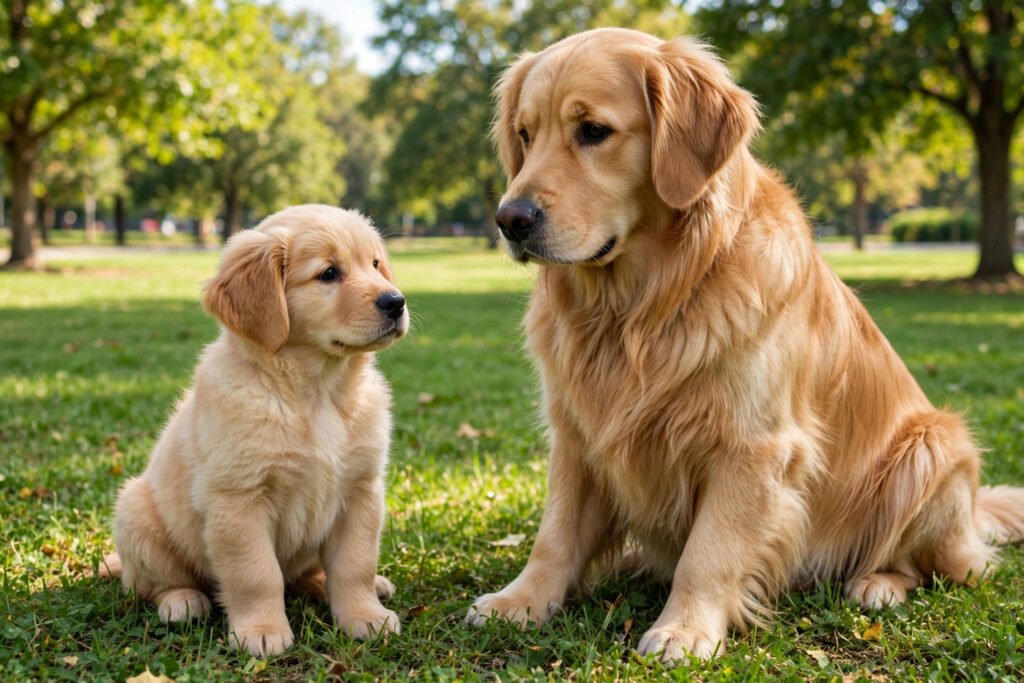
Short answer: most puppies reach about half their adult weight by 16 weeks. Toy breeds are usually fully grown by 9–10 months, while giant breeds keep growing until 18–24 months. Use the chart below — or our free puppy growth predictor — to turn your puppy’s current age, weight, and breed size into an estimated adult weight range.
Knowing roughly how big your puppy will get is one of the most practical things a new owner can figure out early. It affects food amounts, crate and harness sizing, appropriate exercise, and when to switch from puppy food to adult food. Every figure here is an estimate; individual dogs vary, and mixed breeds vary more.
Puppy Growth Chart by Breed Size
Find your puppy’s breed-size category in the first column, then read across for the typical adult weight range, roughly how much growing is done at six months, and when growth is usually complete. If you’re unsure of the category, the parent’s size or your vet’s guess is a good starting point.
| Breed size | Typical adult weight | About % grown at 6 months | Fully grown |
|---|---|---|---|
| Toy | Under 12 lb | ~75% | 9–10 months |
| Small | 12–25 lb | ~70% | 10–12 months |
| Medium | 25–50 lb | ~65% | 12–14 months |
| Large | 50–100 lb | ~55% | 14–18 months |
| Giant | Over 100 lb | ~45% | 18–24 months |
All figures are estimates based on average growth curves. Individual dogs — especially mixed breeds — can land outside these ranges.
The pattern is consistent: smaller dogs grow fast and finish early, while larger dogs grow for much longer. A giant-breed puppy at six months is often less than half grown — that leggy 60-pound Great Dane pup still has a lot of filling out to do.
For a personalized number rather than a range, try the puppy growth predictor: enter your puppy’s age in weeks, current weight, and breed size, and it estimates an adult weight range with a visual growth bar.
When Do Puppies Stop Growing?
Puppies generally reach their full height before they reach their full weight. Small and toy breeds often hit adult height by six to eight months and then spend a few more months filling out their frame. Large and giant breeds keep gaining height well into their first year and continue adding muscle and bulk for months after that.
As a rough guide: toy breeds are typically done growing by 9–10 months, small breeds by 10–12 months, medium breeds by 12–14 months, large breeds by 14–18 months, and giant breeds by 18–24 months. Growth plates — the soft areas at the ends of long bones — close later in bigger dogs, which is one reason vets often advise waiting longer before intense running or jumping with large-breed puppies.
How can you tell growth is winding down? The most practical sign is a stable weight: if your puppy’s weight barely changes over several weeks (and they’re past the typical full-grown age for their size), they’re probably close to done. Pro Pet Pass members can log weight over time with the Weight & Body Condition Tracker and see the trend instead of guessing from a single reading.
What Affects How Big Your Puppy Gets
Adult size is mostly decided before your puppy is born, but a few factors nudge the outcome. Here’s what actually matters — and what doesn’t.
Genetics. This is the big one. The single best predictor of a puppy’s adult size is the size of its parents. With purebreds, the breed standard gives a reliable range. With mixed breeds, look at both parents if you know them; if you don’t, expect more variation, because the puppy can inherit growth patterns from either side of the family.
Nutrition. A balanced puppy food fed in appropriate amounts supports healthy, steady growth — it doesn’t change your puppy’s genetic size. Overfeeding won’t produce a bigger adult; it produces an overweight puppy, which stresses growing joints. Underfeeding is worse: it can impair development without making a healthy smaller dog. Keep your puppy lean (you should feel ribs easily under a thin layer of fat) rather than thin, and follow the feeding guide on the food label or your vet’s advice.
Health. Parasites, illness, or chronic digestive problems during the fast-growth months can slow a puppy down — one more reason puppy vet visits matter.
Spay/neuter timing. The timing of spaying or neutering can influence when growth plates close, which can slightly affect final height and proportions — particularly in large breeds. There’s no one-size answer; talk to your veterinarian about the right timing for your dog.
What doesn’t reliably predict size: paw size (a fun hint, not a measurement), the puppy’s size relative to littermates at eight weeks, and how much they eat. Appetite reflects metabolism and activity, not destiny.
When to Switch From Puppy Food to Adult Food
Most puppies should switch to adult food around the time they reach their expected adult size — which means the timing follows the same size pattern as growth itself. As general guidance: small and medium breeds around 9–12 months, large breeds around 12 months and beyond, and giant breeds up to 18–24 months. Your vet can confirm the right moment for your dog.
When you switch, transition gradually over 7–10 days: start with mostly the old food and a little of the new, shifting the ratio a bit each day. A sudden swap is the classic cause of a week of digestive upset.
Puppy Growth Questions, Answered
How can I tell how big my puppy will get?
The best clues are the size of the puppy’s parents, breed-size averages, and the puppy’s current growth curve. Combining current age, current weight, and breed size — as our free puppy growth predictor does — gives an estimated adult weight range. Paw size is a rough hint, not a reliable predictor, and mixed-breed puppies vary more.
At what age is a dog fully grown?
It depends on size. As a general guide: toy breeds are typically fully grown by 9 to 10 months, small breeds by 10 to 12 months, medium breeds by 12 to 14 months, large breeds by 14 to 18 months, and giant breeds by 18 to 24 months. These are estimates — individual dogs vary.
Do mixed-breed puppies grow less predictably?
Yes. With mixed breeds there is more variation, because the puppy can inherit growth patterns from either parent’s side. If you know the parents’ sizes, use the larger parent as your rough guide. Your veterinarian can also assess body condition and growth at checkups.
When should I switch my puppy to adult food?
Most puppies switch to adult food around the time they reach their expected adult size: roughly 9 to 12 months for small and medium breeds, around 12 months and beyond for large breeds, and up to 18 to 24 months for giant breeds. Transition gradually over 7 to 10 days, and confirm timing with your veterinarian.
Can feeding less keep my puppy smaller?
No. Restricting food will not change your puppy’s genetic adult size, and underfeeding can harm healthy development. Feed a balanced puppy food in the amounts on the label or recommended by your vet, and keep your puppy lean — not thin — as they grow.
Estimate your puppy’s adult size
Charts are a starting point — your puppy’s own numbers are better. Try the free puppy growth predictor: enter age, weight, and breed size for an estimated adult weight range, a full-grown timeline, and a visual growth bar.
Want to watch the trend instead of guessing? Pro Pet Pass members log weight and body condition over time with the Weight & Body Condition Tracker — a year of readings tells you and your vet what’s actually happening.
BlueTarg provides general educational information, not veterinary advice. If you have concerns about your puppy’s growth, weight, or diet, talk to your veterinarian.