
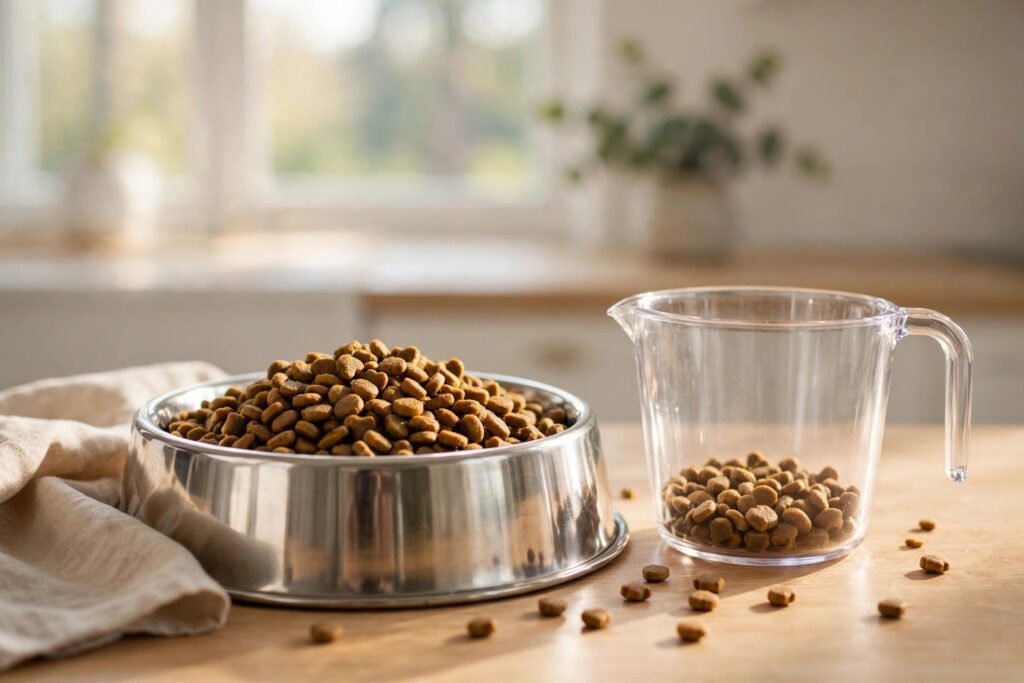
Most adult dogs need roughly 350 to 1,960 calories per day depending on weight — about 1 to 5½ cups of a typical dry food. Puppies need more per pound, seniors often need less. The surest approach: start with a weight-based estimate, then adjust every 2–3 weeks based on your dog’s body condition.
The quick answer: daily portions by weight
If you want a number right now, this table gives weight-based estimates for a moderately active adult dog at a healthy weight who is maintaining (not gaining or losing). Figures use the standard veterinary resting-energy formula — RER = 70 × (weight in kg)0.75 — multiplied by 1.6 for a typical adult, with cups figured at roughly 350 kcal per cup. Treat every number as a starting estimate, not a prescription.
| Your dog’s weight | Daily calories (estimate) | Typical dry food |
|---|---|---|
| 10 lb | ~350 kcal | 1 cup |
| 25 lb | ~690 kcal | 2 cups |
| 50 lb | ~1,160 kcal | 3¼ cups |
| 75 lb | ~1,580 kcal | 4½ cups |
| 100 lb | ~1,960 kcal | 5½ cups |
Falls between rows? A 40 lb dog lands around 950 kcal, or about 2¾ cups. The free portion calculator does the exact math for your dog’s weight, age, and activity level in seconds.
Puppies vs. adults vs. seniors
Puppies are building an entire body, so they need more calories per pound than adults — roughly twice the resting-energy baseline, compared with about 1.6× for a typical adult. That extra fuel gets split into three meals a day until around six months old, when most puppies transition to two. Because growth rates vary enormously — a Great Dane puppy and a Chihuahua puppy are on completely different curves — confirm portions with your vet at each puppy checkup rather than following the bag alone.
For most adult dogs, two meals a day and a steady routine beat free-feeding (leaving food out all day). Scheduled meals make portions easier to measure, and you’ll notice appetite changes sooner — often the first sign something is off.
Around age seven, most dogs’ metabolisms slow and activity drops, so many seniors need somewhat less — roughly a fifth fewer calories than in their adult years is a common estimate. But age alone shouldn’t dictate the portion: some seniors lose muscle and need more protein rather than less food overall. Let body condition and your vet’s guidance drive the decision.
How to tell if the portion is right
The feeding guide on the bag is an average for an average dog; your dog is the final judge. Vets use a 9-point body condition scale, with scores of 4–5 considered ideal. You can do a rough version at home with the rib check: run your hands along your dog’s sides. You should feel the ribs easily under a thin layer of fat, and most dogs should show a visible waist when viewed from above and from the side.
Recheck every two to three weeks after any portion change. If you can’t feel the ribs, trim the daily portion by about 10% and reassess — small adjustments beat dramatic ones. Weigh your dog monthly if you can; a bathroom scale works for small dogs (weigh yourself holding the dog, then subtract), and most vet clinics will weigh larger dogs for free.
Wet food, dry food, and mixing
Calorie density varies far more between foods than most owners expect — dry foods range roughly from 250 to over 450 kcal per cup. That’s why two dogs each eating “two cups a day” can be getting wildly different energy. Always find the kcal figure on your specific bag or can and do the math from there.
Wet food is mostly water, so it packs far fewer calories per cup than kibble. If you feed wet food, divide your dog’s daily calorie target by the kcal per can (or per 100 g) on the label. Mixing wet and dry? Decide the total calories first, then split them — for example, half the calories from kibble and half from wet — rather than feeding a full portion of each.
Frequently asked questions
How many cups of food should I feed my dog per day?
It depends on your dog’s weight and the food’s calorie density. As a rough guide, a 25 lb adult dog needs about 2 cups of a typical dry food (around 350 kcal per cup) per day, while a 75 lb dog needs about 4½ cups. Because calorie density varies widely between brands, always check your food’s label and use our free portion calculator for a personalized estimate.
Do puppies need more food than adult dogs?
Yes — puppies need more calories per pound of body weight because they are growing. A common estimate is around twice the resting-energy needs of an adult dog, split across three meals a day until about 6 months old, then two. Confirm portions with your vet at each puppy checkup, since growth rates vary by breed and size.
How can I tell if I’m overfeeding my dog?
Use the rib check: you should be able to feel your dog’s ribs easily under a thin layer of fat, and most dogs should have a visible waist when viewed from above. Vets score this on a 9-point body condition scale, with 4–5 considered ideal. If you can’t feel the ribs, reduce portions by about 10% and re-check in 2–3 weeks.
Does this calculator work for wet food?
The calorie estimate works for any food, but the cups conversion assumes dry kibble at about 350 kcal per cup. Wet food is mostly water, so it has far fewer calories per cup. Check the kcal per can or per 100 g on the label, then divide your dog’s daily calorie target by that number.
How many meals a day should my dog get?
Puppies under 6 months do best with 3 meals a day; most adult and senior dogs do well on 2. Splitting food into meals (rather than leaving it out all day) makes portions easier to control and helps you notice appetite changes early.
Should I feed my senior dog less than an adult dog?
Often, yes — many dogs over 7 need somewhat fewer calories as their metabolism slows and activity drops, roughly a fifth less than in their adult years. But some seniors lose muscle and need more protein, not less food. Base changes on body condition and your vet’s guidance, not age alone.
Want your dog’s exact number?
Enter your dog’s weight, age, and activity level and get a personalized daily calorie and portion estimate in under a minute.
Try the free Dog Food Portion Calculator
Feeding raw or home-cooked? Pro Pet Pass members get the Meal & BARF Formulator for precise meal plans built around their dog.
BlueTarg provides general educational information, not veterinary advice. Every dog is different — if your dog has a health condition, takes medication, is pregnant or nursing, or you’re unsure about their ideal weight, talk to your veterinarian before changing how much you feed.